
Household-Oriented Micro Ecosystem (HOME)
Location: Khalishkhali Union, Tala Upazila, Satkhira District, Bangladesh
Duration: 12 Months
Implementing Organization: SESDO (Social & Environmental Sustainable Development Organization)
Project Lead: Tapas Kumar Mollick
Tagline: “One Home = One Ecosystem = One Climate Solution.”
Background & Problem Statement
Satkhira District is one of the most climate-vulnerable regions in Bangladesh, facing severe soil and water salinity, cyclones, tidal floods, waterlogging, and declining agricultural productivity. Households are experiencing increasing food insecurity, livelihood loss, unemployment among youth and women, biodiversity degradation, and persistent poverty.
Existing eco-village or resilience programs are mostly large-scale, expensive, and not accessible to low-income families. Household-level resilience remains extremely weak, leaving families highly exposed to climate shocks. SESDO introduces the HOME Model (Household-Oriented Micro Ecosystem), a low-cost and scalable solution for climate-vulnerable households in coastal Bangladesh.
The gap:
There is no structured, low-cost, climate-adaptive household ecosystem model available for rural families in Bangladesh.
Project Goal
To transform vulnerable households into climate-resilient, self-sufficient, and environmentally sustainable micro-ecosystems that collectively strengthen community resilience.
Objectives
- Build Household Resilience
- Establish 30 fully functional HOME units
- Achieve significant improvement in household food self-sufficiency
- Promote Organic & Climate-Smart Agriculture
- Support homestead cultivation of vegetables, fruits, spices, and medicinal plants
- Diversify Livelihoods
- Introduce poultry, goat rearing, small aquaculture, and household nurseries
- Empower Women & Youth
- Women: livestock, nutrition, home-based enterprises
- Youth: nursery development, forestry, green entrepreneurship
- Enhance Biodiversity & Climate Action
- Increase homestead tree cover, pollinator presence, and soil health
Project Approach: HOME Model
Each HOME Unit includes:
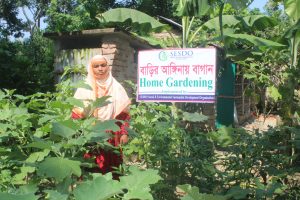
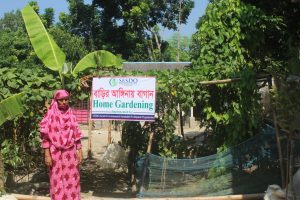
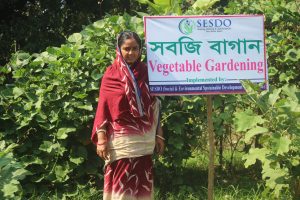
- Homestead vegetable gardens (12–15 varieties)
- Fruit & timber trees (including mango, guava, papaya, lemon, coconut and betel nut)
- Small fish ponds (tilapia, carp, koi)
- Poultry, goats, cows
- Spice, herbal, and medicinal plants
- Composting and biofertilizer systems
- Water management and rainwater harvesting
- Renewable energy options (solar where feasible)
This creates a closed-loop micro-ecosystem providing food, income, nutrition, and climate resilience within the household boundary.
Key Activities
- Household Ecosystem Development
- Homestead vegetable & spice gardens
- Integrated fruit orchards with coconut & betel nut trees
- Pond-based aquaculture
- Poultry and small livestock
- Compost pits and biofertilizer production
- Waste-to-resource systems
- Capacity Building
- Climate-smart agriculture and organic farming training
- Women’s livestock, nutrition & home-enterprise workshops
- Youth-led nursery and agroforestry training
- Aquaculture and pond management sessions
- Nature-Based Solutions (NBS)
- Homestead forestry and tree planting
- Pollinator-friendly garden development
- Rainwater harvesting
- Soil regeneration through organic methods
- Market Linkage & Sustainability
- Surplus sale of vegetables, eggs, milk, and fish
- Youth-run nurseries
- Women-led micro-enterprises
- Linking households with local markets and buyers
Expected Results
- 30 climate-resilient, fully functional HOME units
- Improved household food security and reduced dependency on markets
- Long-term livelihood support through coconut & betel nut production
- 30 women-led livestock activities
- 30 youth-led nurseries and agroforestry initiatives
- Household income increases by 30–40%
- Enhanced biodiversity and greener homesteads
- Reduced household carbon footprint through organic farming and tree planting
Sustainability Strategy
Financial Sustainability:
- Surplus food, eggs, milk, fish, seedlings generate regular income
- Youth-led nurseries grow and sell tree seedlings
- Household production reduces daily expenses
Environmental Sustainability:
- Increased homestead tree cover with coconut and betel nut
- Organic farming restores soil, reduces emissions, and improves biodiversity
- Nature-based systems ensure long-term ecological balance
Social Sustainability:
- Household ownership ensures long-term continuation
- Peer-to-peer learning motivates neighboring families
- Community clusters support scaling and replication
Target Beneficiaries
Direct: 30 households (150–200 people), including women, youth, small/marginal farmers
Indirect: Over 1,000 community members benefiting from demonstration and adoption
SDG Alignment
SDG 1, SDG 2, SDG 5, SDG 8, SDG 12, SDG 13, SDG 15.
Impact Statement
“One Home = One Ecosystem = One Climate Solution.”
The HOME model empowers families to produce their own food, generate income, build resilience, and restore environmental health—proving that climate solutions can begin at the household level, one home at a time.