
Fish Enclosure-Based Vegetable Farming
Executive Summary:
Climate change poses one of the most critical challenges for Bangladesh, especially in coastal regions such as Satkhira, Khulna, and Bagerhat. Rising salinity, water scarcity, erratic rainfall, and extreme weather events are threatening traditional agriculture, reducing crop yields, and increasing economic vulnerability among rural farmers. These challenges also exacerbate social issues, including malnutrition, poverty, child labor, and educational dropouts.
In response, SESDO (Social and Environmental Sustainable Development Organization) is implementing Fish Enclosure-Based Vegetable Farming, an innovative approach that integrates fish farming with vegetable cultivation on the raised aisles surrounding fish enclosures. This method ensures food security, economic resilience, and sustainable livelihoods for smallholder and socially marginalized farmers.
Background
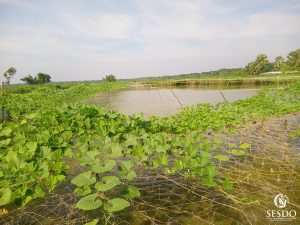
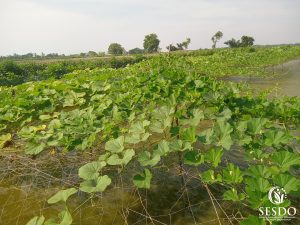
Coastal areas of Bangladesh are naturally suited for aquaculture due to brackish water systems. Local farmers construct raised aisles around fish enclosures, known regionally as fish cages, which provide fertile soil ideal for vegetable cultivation.
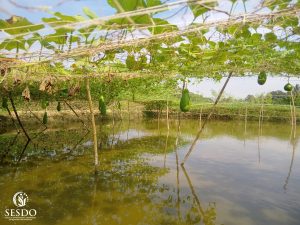
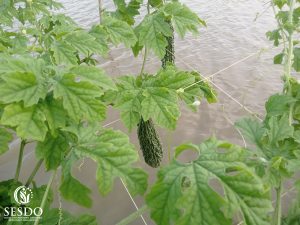
Farmers are now combining fish farming with vegetable gardening to diversify income and improve household nutrition. Vegetables commonly cultivated include bitter gourd, yardlong bean (barbati), beans, sweet pumpkin, gourd, and papaya. The organic soil in the fish enclosure aisles supports high-yield production, ensuring both economic and nutritional benefits.
Case Studies
Farmer Amal Mallick from Shovna village, Dumuria Upazila, Khulna, has successfully practiced fish enclosure-based vegetable farming for 3–4 years. His crops include bitter gourd and yardlong beans, alongside fish farming. Recently, he sold 80 kg of bitter gourd and 20 kg of yardlong beans at profitable market rates. Amal projects weekly harvests of 500–600 kg of bitter gourd in the next 10–15 days.
Farmer Sankar Mallick notes that most of the vegetables supplied to Khulna city now come from Shovna village, with some reaching Dhaka. Both farmers report substantial economic self-sufficiency through combined fish and vegetable production. For example, Amal’s total investment this year was BDT 75,000, while his projected profit from fish and vegetables is between BDT 150,000–200,000.
Rationale & Social Impact
Climate change, natural disasters, and salinity have disrupted conventional agriculture, leaving farmers vulnerable. Fish enclosure-based vegetable farming demonstrates how climate-adaptive practices can improve food security and livelihoods, particularly among socially marginalized and economically backward communities.
SESDO plans to scale this initiative, combining training, technical support, and community mobilization to ensure broader adoption. The project addresses:
- Sustainable agriculture in salinity-prone areas
- Economic empowerment for women, youth, and marginalized groups
- Improved nutrition and food security
- Social development and rural livelihoods aligned with the SDGs
SESDO’s CSA-3 Integration
This project complements SESDO’s broader CSA-3 Formula, integrating:
- Climate-Smart Agriculture (CSA): Organic vegetable gardening and climate-resilient crop cultivation.
- Climate-Smart Agroforestry (CSA): Tree integration for soil fertility and environmental sustainability.
- Climate-Smart Agritourism (CSA): Farm- and village-based tourism promoting sustainable practices.
By implementing fish enclosure-based vegetable farming at scale, SESDO demonstrates innovative, climate-resilient, and socially inclusive agriculture that enhances food security, livelihoods, and community well-being in Bangladesh’s coastal regions.
Conclusion
The Fish Enclosure-Based Vegetable Farming project is the first of its kind in Bangladesh. By combining aquaculture with vegetable cultivation, SESDO empowers farmers to overcome climate-induced challenges, improve household income and nutrition, and promote sustainable agriculture. With proper training, support, and replication, this model can transform coastal farming communities, fostering resilience, economic growth, and food security in the face of climate change.