
SESDO’s CSA-3 Formula in Bangladesh in the Context of Climate Change
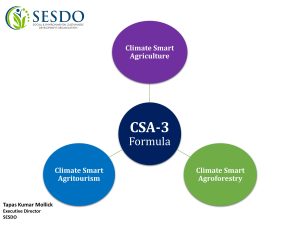
 Bangladesh, agriculture, farmers, rural life, nature, coastal areas, mangrove forests, and biodiversity are all intertwined. But due to the threat of climate change, this beautiful flower garland has been randomly messed up. In this context of climate change, if we want to keep our beautiful Bangladesh beautiful, it has become necessary to take some steps. Climate Smart Agriculture, Climate Smart Agritourism, and Climate Smart Agroforestry can be important steps. Time has passed; there is no room for partial thinking or partial action. Climate-smart agriculture, climate-smart agritourism, and climate-smart agroforestry should not be considered separately, and we should move forward by coordinating and integrating these three parts. And the part composed of these three is CSA-3 Formula. We hope and believe that the CSA-3 Formula can play an important role in the case of countries like Bangladesh in this dire time of climate change.
The Food and Agriculture Organization of the United Nations (FAO) defines Climate Smart Agriculture (CSA) as agriculture that sustainably increases productivity, increases resilience, reduces GHG where possible, and improves the achievement of national food security and development goals. 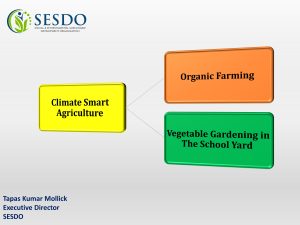 There is a lot of research into climate-resilient smart agriculture systems, with many good results, and in practice, we can see as such, that new salinity-tolerant cultivars are being developed and cultivated in salinity zones. Different varieties of climate-tolerant vegetables are being cultivated in the courtyards of residential houses, and employment arrangements are being made for rural women. Concerned about climate change and food security, the Honorable Prime Minister of Bangladesh, Sheikh Hasina, announced that not even an inch of arable land should be spared. From red cabbage to brinjal, gourd, bitter gourd, Malabar spinach, pepper, and all kinds of vegetables can be cultivated in the yard of the house.
Climate Smart Agroforestry (CSA) can be defined as the deliberate integration of trees and shrubs into crop and livestock farming systems to create environmental, economic, and social benefits. If we imagine the condition of our villages in Bangladesh in connection with the above-mentioned climate-smart agriculture, then, with a little planning, agroforestry can be introduced very easily. 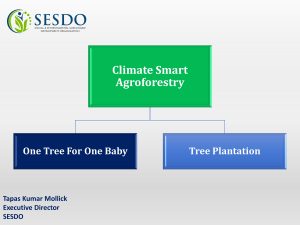 If we can produce crops and trees at the same time, on the one hand, food security is ensured; on the other hand, the balance of the environment, environmental sustainability, ecosystems, and biodiversity conservation will also be ensured. Along with the environment, radical economic development in rural society is also possible. We have also seen a family raising money by selling trees during crisis time, and a mother raising money for her son’s education cost by selling trees.
Climate Smart Agritourism (CSA), on the other hand, can be defined as a form of tourism where tourists stay on farms or agricultural villages, either to experience farm life or as a base for exploring the countryside. Agritourism, through which visitors can experience how a farm works, can contribute to sustainable agriculture and improve the quality of life of people affected by climate change. 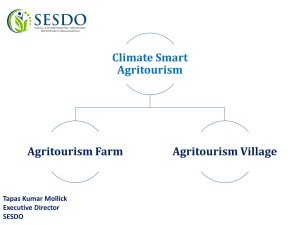 In this field, I want to mention only two things: first, the agritourism farm, and second, the agritourism village. If we compare the above-mentioned Climate Smart Agriculture and Climate Smart Agroforestry systems with fragmented agricultural land and then think of a specific area of fragmented agricultural land and add some tourism elements to it, Agritourism Farm and Agritourism Village come to mind first. I like to call the combination of agritourism farm and agritourism village as climate-smart agritourism.
Some parts of the CSA-3 formula have already started separately in Bangladesh. Among them “Growing Vegetables in the Backyard”, “Vegetable Gardening in the School Yard”, “Organic Farming”, “Agritourism Farm”, “One Tree for One Baby”, “Forestry for the Future”, “Use Jute Products”, “Mangrove Forest” (Sundarbans) is our friend,” and “Agritourism Village” projects are among the most notable ones.
According to the Global Climate Risk Index, Bangladesh is one of the most vulnerable countries in the world to climate change. It may be affected by sea level rise and saltwater intrusion, an increase in average temperature (1.7°C by 2050), the variability of precipitation, and an increase in the frequency and intensity of extreme weather events. Each of these factors will significantly affect the country’s agriculture and forestry. And this effect directly affects the lives of ordinary people. By considering productivity, adaptation, and mitigation, the Climate Smart Agriculture, Climate Smart Agritourism, and Climate Smart Agroforestry (CSA-3) formula can play an important role in addressing the challenges of climate change. (CSA-3) formula limits greenhouse gas emissions, reduces waste and pollution, and protects and restores ecosystems. Overall, the CSA-3 formula can help reduce negative environmental impacts and ensure environmentally, economically, and socially sustainable initiatives. (CSA-3) Formula’s sole objective is to reduce emissions from agriculture, forestry, and other land uses. The Bangladesh Climate Change Strategy and Action Plan (BCCSAP) 2008, through a full consultative process involving government, civil society, and development partners, outlined six pillars to achieve ultimate success.
The six pillars are:
- Food security, social protection, and health
- Comprehensive disaster management
- Infrastructure
- Research and knowledge management
- Mitigation and low carbon development
- Capacity building and institutionalization
If we consider the future context, we can see that Bangladesh needs to adopt an integrated action plan based on the six pillars of the Climate Change Action Plan 2008, where mitigation and low-carbon development play an important role. Considering this, Bangladesh has submitted revised Nationally Determined Contributions (NDCs), central to the Paris Agreement, in 2021 to reduce national emissions and adapt to climate change impacts. IFAD has included in its Country Strategic Opportunities Program 2023-2028 for Bangladesh to strengthen climate resilience through infrastructure and climate-smart agriculture. Under the Bangladesh Climate Change Initiative, the government has researched drought, cold, waterlogging, disease, pests, and salinity, and developed salt-tolerant crop varieties to combat the changing climate. Also, Bangladesh needs to undertake various activities for sustainable agriculture and green growth to achieve the goals and objectives of the Eighth Five-Year Plan. One thing we have to remember is that to achieve upper middle-income status by 2031 and, mainly, to take advantage of the fourth industrial revolution, the improvement of hard and soft skills must be mandatory.
Satkhira is a coastal district of Bangladesh where about 22 lakh people live. The people of this region are directly affected by climate change. Due to salinity, there is a water problem in the region, and because of this water problem, no crops are growing, and a lack of crops is not producing food. People are suffering from food problems; people are suffering from malnutrition due to a lack of food; people are not able to work on agricultural land; then it is seen that they are not getting food; there is no work; people are living in poverty. Humans are forced to over-depend on forests, water resources, and mangrove forests in their quest for survival, resulting in forest destruction, water imbalances, and mangrove forests being damaged. And its impact is directly related to climate change. And from the opposite direction, these harmful effects of climate change are coming to the coastal population.
Now is the time to adapt to climate change and expand climate-resilient agricultural systems. SESDO initially piloted the Climate Smart Agriculture project in marginal areas of Satkhira district. SESDO’s project has been successful in improving climate change-tolerant varieties of agriculture. Seeing this successful project of climate-smart agriculture, other farmers in the area are also encouraged. Under the initiative of SESDO, local youth and other farmers have also started this farming system through training.
Seeing the success of the Climate Smart Agriculture project, SESDO has decided that this agricultural system can be made sustainable. In that context, SESDO has undertaken another new project, which is the Agritourism Village. This project is going to be the first in the history of Satkhira district. SESDO has designated Katakhli village in Tala Upazila to implement this agritourism village project. SESDO believes that the three projects—Climate Smart Agriculture, Climate Smart Agritourism, and Climate Smart Agroforestry—are interrelated. If the CSA-3 formula can be established and this CSA-3 project can be implemented and kept running simultaneously, this project will ensure sustainable agriculture on the one hand and, on the other hand, accelerate climate change-resilient agriculture.
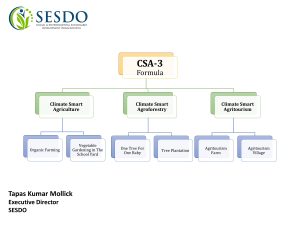
Most interestingly, I am talking about the CSA-3 formula. Within this CSA-3 formula, from pesticide-free vegetable cultivation to climate-resilient agriculture systems, farmers, women employment, entrepreneurship, beekeeping, rainwater conservation, forests, and biodiversity Conservation, wildlife conservation, use of jute products instead of plastic, nurseries, forestry, social forestry, Agro-forestry, ecological balance, conservation of mangrove forests, nature-based solutions, food security, tourism, Agri-tourism, eco-friendly Agri-economic activities Ensuring social and economic security of coastal communities, especially the most vulnerable and marginalized communities, improving socio-economic quality of life, employment, protein, health, and ecological balance are all reflected.
Finally, one thing to say is that social change initiatives are essential for the success of the CSA-3 formula. Therefore, on the one hand, massive campaigning and support are needed to focus the issue on agriculture and forest dwellers. On the other hand, technological upgrading of their behavior is equally important. SESDO (Social and Environmental Sustainable Development Organization) has been working tirelessly since 2017 in the coastal regions of Bangladesh, including Satkhira, Khulna, Jashore, and Bagerhat districts. SESDO’s job is to discover and implement new unique ideas, concepts, projects, and formulas for the welfare of the environment, people, and society. As a result, today we present the CSA-3 formula to the world. From the beginning, one of the goals of SESDO was to ensure food security, sustainable social security and economic security while keeping the balance of the environment and ecology by implementing new projects using innovative ideas in the global context of climate change.